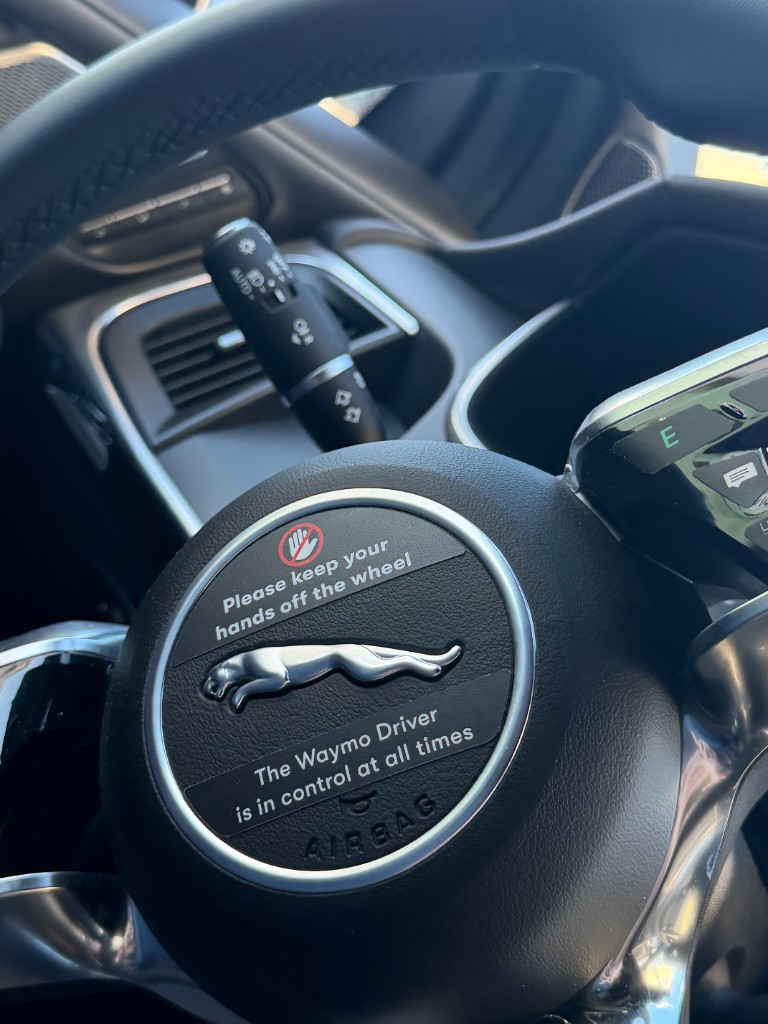
“Hello, Haley”
On the humiliation of enjoying the future.
October 2025
The first time I took a Waymo, I was with my boyfriend Raphaël. We were both against the idea on principle, which is to say we had discussed its social harms at length and were now waiting for the autonomous Jaguar to arrive.
On principle, we disliked the privatization of transit, the replacement of human workers, and the fantasy that every social problem could be solved by sealing oneself inside a luxury appliance and routing around it. On principle, we believed cities should have trains, buses, sidewalks, civic life, and above all, people—Raphaël especially, being French and from Paris, where public transportation is less a convenience than a civic inheritance. On principle, we did not want to become the kind of people who summoned driverless Jaguars to take us across town while muttering about the collapse of civilization from the backseat.
But we had seen them everywhere.
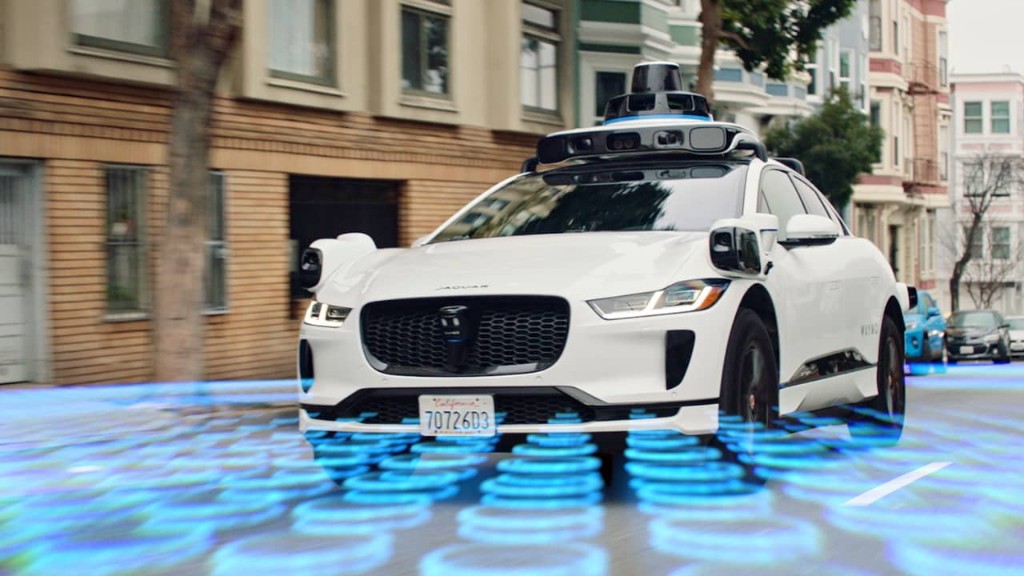
They moved through San Francisco with the calm, watchful patience of something that had learned the rules but not the place: white Jaguars with little domes on top, obeying the speed limit with unsettling conviction, braking the instant a light turned yellow, pausing so long at stop signs that everyone behind them seemed briefly tempted by violence. They were always clean, the driver’s seat always unpeopled. A normal empty car looks abandoned; a Waymo looks occupied by an intelligence that had decided not to show itself.
For weeks, I had watched them pass with the same feeling I had when I saw a very expensive stroller, a billionaire in athletic wear, or an A.I. billboard explaining, in enormous sans serif font, that the future loved me personally: disgust, curiosity, and the faintest premonition of desire.
“We have to try it once,” my boyfriend said.
“I know,” I said.
We ordered it near Coit Tower, in that part of San Francisco where the city briefly convinces you it is a European fantasy before immediately sending you past a man screaming into a traffic cone. The tower stood behind us, pale and ridiculous on its hill, like a monument to someone’s decorative optimism. Below it, the streets tilted and folded into one another. The bay flashed between buildings. Tourists stood around looking windblown and betrayed by their sweaters.
The app told us the car was arriving.
I expected some ceremony, or at least some visible evidence that a threshold was being crossed. Instead, a white Jaguar pulled up with its hazard lights blinking politely and my initials, “HM,” faintly glowing on the dome. It looked expensive, spotless, and faintly embarrassed by the city around it. There was no driver. No one turned around to check whether we were the right people. No one mispronounced my name. No one asked if I minded if they took a personal call on speakerphone for twenty-seven minutes. The car simply unlocked itself.
I opened the door.
“Hello, Haley,” it said.
The voice was not quite human. It was not robotic in the old way, either, not tinny and charmingly bad. It had the polished neutrality of something designed by a team of people who had spent months making sure it did not sound like it wanted anything. But of course that made it worse.
I froze with one foot in the car.
“No,” I said.
My boyfriend laughed.
“It knows you,” he said.
“That’s not funny.”
The car waited. This was one of its more upsetting qualities. It waited without impatience, which made me feel rude. A human driver waiting for you has a body, mood, facial expression, and an opinion about your shoes. This was different. The car had no mood, no eyebrows, no visible contempt. It created a vacuum into which I immediately supplied my own guilt.
We got in.
The doors shut with the soft, expensive finality of a decision made by someone richer than you. Inside, the car was immaculate. The seats were wide and leather and absurdly comfortable. The temperature was adjustable. The screen welcomed me by name. I could choose music, silence, air flow, route. The car informed us that we could begin the ride when we were ready, as if we were not already participating in several systems beyond our control.
I pressed start.
The Jaguar pulled away.
There are experiences one wants to hate more than one actually hates them. This was one of them.
The ride began smoothly...too smoothly. The car eased into traffic with a caution so refined it bordered on moral superiority. It stopped at crosswalks. It allowed aggressive drivers to cut in. It seemed to understand every pedestrian as a lawsuit waiting to become a person. There was an electric hum underneath us, a soft mechanical purr that made the whole car feel alive in the wrong category. Not alive like a horse, which at least has the dignity of fear, but alive like a refrigerator that has developed private ambitions.
My boyfriend leaned forward, studying the screen.
“It’s very impressive,” he said, in the tone people use when betraying themselves.
“Don’t say that.”
“It is.”
“I know it is. That’s the problem.”
We had spent enough time around A.I. people by then to recognize the structure of the trap. First, something was unnerving. Then it was convenient. Then it was normal. Then it was infrastructure. By the time anyone asked whether it should exist, they were already irritated when it took more than six minutes to arrive.
The car took us down from the hill and into the city’s shifting geographies. San Francisco is not a large city, but it has the psychological density of a much bigger one. You can move ten blocks and pass through five moral weather systems. There are neighborhoods where everyone appears to be drinking natural wine in shirts made of gauze, and neighborhoods where a man is barefoot outside a CVS at noon, negotiating with an invisible enemy. There are houses worth several million dollars with front doors the color of fresh lemons, and tents pitched beneath billboards advertising machine intelligence as a lifestyle upgrade.
The Waymo moved through all of it with the same serene attention.
This, more than anything, disturbed me. A human driver reacts to a city. He sighs at a cyclist, swears at a bus, brakes too hard, laughs at something on the sidewalk, tells you which neighborhood used to be better before the tech people came, though he is also driving for a tech company and you are sitting in the back of his car because you could not figure out the bus. A human driver gives you, however unpleasantly, evidence that the city is being perceived by another person.
The Waymo perceived everything and seemed to feel nothing.
We passed an A.I. billboard. Then another. Then another. They loomed over the street with the bland menace of corporate prophecy. One promised superhuman productivity. Another suggested that intelligence itself had become a service. A third featured a phrase so abstract I forgot it immediately, which I suspected was the point.
Outside, a man sat folded over on the sidewalk, his spine curved so sharply he seemed less asleep than abandoned by gravity. A few blocks later, another person stood bent at the waist, motionless, one hand touching the pavement. There were people wrapped in blankets, people pushing carts, people arguing with the air. There were young men in Patagonia vests walking past them with lattes, and I was one of those people too, except seated inside a driverless Jaguar with climate control.
There is wealth disparity in other cities, in most cities, but what makes San Francisco unique is its refusal to hide the contradiction. It displays it with almost theatrical confidence. Luxury and collapse share intersections. You can be in a car without a driver, watching a person without a home. You can pass a billboard for artificial general intelligence while someone on the curb appears to be losing the basic conditions of being human.
The car turned.
A woman on the sidewalk looked directly at us and raised her middle finger.
It was not even especially angry. It was efficient, almost administrative. A simple gesture of civic feedback.
I laughed, then felt bad for laughing, then felt that she was right, then continued enjoying the seat.
“There it is,” my boyfriend said.
“She’s correct,” I said.
“Probably.”
The Waymo did not react. This, too, seemed offensive. A human driver might have rolled down the window, or yelled something, or pretended not to see. The Waymo accepted the gesture into its field of vision and proceeded. It had no pride to injure and no masculinity to defend. You could insult it, and it would still get you to the Mission by the optimal route.
I thought, not for the first time, that this was what made the technology so powerful. It did not need to win the argument. It only needed to work.
We entered the Tenderloin, where the city’s contradictions lost their rhetorical quality and became bodies on the sidewalk. The streets looked bruised. People moved slowly or too fast. Storefronts advertised liquor, checks cashed, discount electronics, spiritual services, pho. A man leaned against a pole with his pants halfway down. A woman shouted at no one and everyone. The Waymo paused at a light beside a tent whose blue tarp snapped in the wind.
Inside the car, the air remained exactly the temperature I had selected.
This felt obscene (it also felt pleasant).
I do not know what to do with this fact, except report it accurately. A great deal of moral life in San Francisco consists of discovering that the thing you object to is also, in some immediate sensory way, nicer than the thing it replaces. The city specializes in this humiliation. Food delivery is exploitative, but the ramen arrives hot. Amazon is evil, but the package arrives overnight. A.I. threatens labor, art, education, language, and possibly the last remaining excuses humans have for talking to each other, but it can summarize a PDF in seven seconds. The Waymo represents a grim and automated future, but the seats are excellent, and no one is making me listen to trap music at a volume that suggests the driver is trying to restart his own heart.
I had taken many Ubers by then. Some were fine. Some were not. A few were driven by men who seemed to experience my presence in the backseat as an invitation to narrate their divorce, investment strategy, spiritual awakening, or theory about women. Several had smelled strongly of weed. One smelled like weed and cologne, which is worse, because it implies an attempt at repair. Many had terrible music playing, by which I do not mean music I disliked, but music that made the car feel less like transportation than an unwilling audition for someone’s inner life. There had been creepy phone conversations, sudden lane changes, locked doors that made me conscious of my body in the backseat, and the strange female calculation that begins whenever you get into a car with a man you do not know: Is he normal? Does he know where he is going? Is he going to comment on my appearance?
I hated that Waymo solved this. This was the part I found hardest to admit; as a twenty-seven-year-old woman, I felt safer in the empty car.
There was no driver to assess or rearview mirror through which I could be watched. No pressure to be friendly, but not too friendly; grateful, but not inviting; quiet, but not rude. The Waymo did not ask what I did. It did not tell me I looked tired, which men often seemed to believe was a form of intimacy. It did not take the long way while insisting it knew a shortcut. It did not need me to reassure it.
It just drove.
This should have been liberating. Instead it made me furious in the way solutions sometimes do when they reveal the depth of the problem. I did not want to be grateful to a robot car for not harassing me; I wanted the world that made the robot car preferable to feel ashamed of itself.
My boyfriend and I sat in silence for a while. The car hummed while the city rearranged itself outside the windows.
The Waymo turned toward the Mission. The light changed. The buildings flattened and brightened. Murals appeared. Taquerias, bars, vintage stores, bookstores, bakeries, men with dogs, women with tote bags, young people dressed as though they had been styled by an algorithm trained on other young people. The Mission had the feeling of a neighborhood constantly being memorialized by the people replacing it. Everyone loved its authenticity, which is usually the first sign that authenticity has been priced into the rent.
We passed another autonomous car. For a moment our Waymo and the other Waymo regarded each other across traffic, two white animals of the same species meeting in the wild. I wondered whether they communicated. I wondered whether they were lonely. This was ridiculous, but San Francisco encouraged this kind of error. The whole city seemed designed to make you anthropomorphize machines and mechanize people.
The car stopped at a four-way intersection. A cyclist waved us through. The Waymo declined. The cyclist waved again, annoyed now. The Waymo waited. Another car honked. The cyclist finally went. The Waymo proceeded with the serene inflexibility of something that had never been socially embarrassed.
“That’s very San Francisco,” my boyfriend said.
“What is?”
“A conflict between a cyclist and an autonomous vehicle, mediated by passive aggression.”
The more I sat in the Waymo, the more it seemed to reorganize the category of riding in a car. It was not a taxi, but it was not quite public transit either. It was closer to being inside an app that had grown upholstery. Everything about it had been designed to remove friction: the greeting, the temperature, the route, the music, the lack of small talk, the absence of tipping, the calibrated voice that reassured without becoming intimate. It was what every consumer technology aspired to be: a private environment in which other people had been minimized.
This was also what made it disturbing. Cities are, among other things, machines for forcing encounters. You share air, noise, inconvenience, danger. You become briefly accountable to strangers. You sit beside someone on a bus who is eating something fragrant from a paper bag. You hear a conversation you were not meant to hear. You are delayed by someone else’s crisis. You remember that your life is not the only life occurring.
The Waymo offered a different proposition: a city without sensory contact.
And because I am not a saint, I liked it.
I liked not having to talk. I liked choosing the temperature. I liked the clean seats. I liked that my boyfriend and I could speak freely without a stranger listening. I liked that the car did not smell like anyone. I liked that it was cheaper than Uber at the time, which made the whole experience feel less like luxury and more like a loophole. The app had discovered the exact price at which moral discomfort becomes market adoption.
This is another thing Silicon Valley understands very well. Most people do not need to be persuaded to abandon their principles; they just need the new thing to be slightly cheaper, cleaner, and easier to use. Then they will preserve their principles as commentary.
I watched the city pass—homeless people, billboards, apartment buildings with bay windows, restaurants where people spent thirty dollars on salads, the buses we should have been riding, the people who hated the cars, the people who had already surrendered, the people who would surrender later, in private, while saying they still had concerns.
The Waymo voice spoke again, gently informing us of something about the route. I disliked its calm amd how quickly I had accepted it. A few minutes earlier, “Hello, Haley” had seemed like a transmission from an alien occupying force. Now it was merely part of the ride.
By the time we arrived, I had become less interested in whether the Waymo was good or bad than in the more humiliating question of what kind of bad things we are willing to enjoy. The car had not converted me ideologically. It had done something more effective. It had given me a good ride.
It pulled over neatly, and the screen thanked me. The doors unlocked.
I stepped out into the Mission, back into weather, noise, people, smell, the ordinary defenselessness of having a body in a city. The Waymo waited until both of us were clear, then pulled away without drama. No goodbye or awkward eye contact. It merged back into traffic and disappeared among the buses, Ubers, bikes, scooters, delivery trucks, and other machines pretending to serve us while redesigning the terms of our surrender.
My boyfriend looked at me.
“Well?” he said.
I hated the answer.
“It was great,” I said.
And then, because San Francisco had already begun its work on me, I opened the app to see how much it would cost to get home.